Oldskool wrote:
Correct me if I'm wrong..........
14.7:1 is richer than 15.4:1 ON THE SAME FUEL.
Correct, because the figures denote a ratio, where the first figure in the ratio is the proportion of air, the second figure is the proportion of fuel.
Oldskool wrote:Runing propane at 15.4:1 as opposed to 14.7:1 looks like we have more air = leaner mixture but you have to be careful about what you mean by "lean" and "rich".
Got to be careful with wording though! 15.4:1 is the correct (stochiometric) ratio for propane, 14.7:1 for petrol, so burning propane at 15.4:1 or petrol at 14.7:1 will leave a similar proportion of oxygen in exhaust gases in either case, even though more air is used to burn a kg of LPG than is used to burn a kg of petrol. It is the proportion of oxygen in exhaust gases that exhaust gas analysers use to calculate afr, so if we use an afr meter calibrated for petrol then for stochiometric burning of LPG it should still read 14.7:1 as opposed to 15.4:1. I.e. If an exhaust gas analyser afr meter calibrated for petrol reads 14.7:1 running on propane, then the actual afr running on propane will be 15.4:1.
Oldskool wrote:Air/fuel ratios are quoted by mass. The molecular mass of propane is lower than that of petrol and in fact you're always burning very many more molecules of propane (as opposed to petrol) for the same amount of air. So by confusing the terminology you might even say that propane always runs "richer".
I don't know much about chemistry, so if you say so! At school I quickly took dislike to chemistry because I like to know things from the base up and in chemistry you don't get to know the route of much because the real roots of chemistry are in the domain of quantum physics.. So it didn't really wash with me when the chemistry teacher attempted to explain the cause of chemical reactions, all to do with numbers of electrons in specific orbital plains etc, when he couldn't then explain why certain electron orbital plains could hold only a certain number of electrons... but this did serve to make me more interested in physics, though I'm not exactly up to Brian Cox' standard in physics either! Nevertheless a quick search on the net gives me the impression you're essentially right.. If molecular weight of propane is much lower than molecular weight of petrol but by mass (not molecular mass) a very similar amount of oxygen is needed to burn either fuel, then less air must be needed to burn each molecule of propane than each molecule of petrol, and in this context we might consider propane burns richer than petrol.. But the AFR's we commonly refer to are based on mass not molecular mass... If we have a kg of two fuels and one of those fuels has half the molecular mass than the other fuel, then we still have a kg of both fuels but we have twice the number of molecules of the lightest molecular mass fuels.. I know there is a way of calculating the number of molecules of either fuel that will react with a certain number of molecules of oxygen but then to arrive back at an afr useful for our purposes we would need to factor in how mow many molecules of fuel weighed a kg and how many molecules of oxygen weighed a kg.. If you were giving someone a 1/4 pound of raisens and a half pound of apples because the person needed these ingredients for cooking and their recipe said to use them in that ratio (and the person didn't want to have any raisens or apples left over), one approach would be to calculate how many raisens and apples to give them based on the weight of one raisen and one apple, or a far simpler approach would be just to weigh the ingredients... With ratios based on mass, the number of raisens in a pound and the number of apples in a pound are pretty irrelevant, as are the number of molecules of fuel and number of molecules of oxygen. In cooking the writer of the recipe might have some formula for the perfect ratio of number of raisens versus number of apples but when writing the recipe book will simplify the ratio to weight of raisens versus weight of apples - It wouldn't make much sense for the cook to count out raisens but that would be more sensible than us trying to count out molecules.
Oldskool wrote:strictly speaking there is only an average molecular mass for petrol since it's a blend of different molecules, whereas uncontaminated propane isn't
yes but would think since the smallest drop of petrol will contain millions of molecules, the different molecules in each tiny drop will average out so comparing the properties of one tiny drop to another tiny drop would reveal no discernible difference.[/quote]
Oldskool wrote:Ah.........but the calorific value of propane is lower than petrol, so the same mass of petrol should be using up more air, so therefore running propane at 15.4:1 (on a mass:mass basis) is still running weak, in fact more so.
No, calorific value tells of how much heat will be produced by completely burning a set quantity of fuel, only related to afr because there must be enough oxygen to burn that quantity of fuel. We already know (from the AFRs based on mass) that burning 1kg of petrol should use 14.7kg of air and that burning 1kg of propane should use up 15.4kg of air. If calorific value of petrol and propane were the same, this in itself would tell us we would need more air to generate the same heat burning propane compared to burning petrol. We already know (from the calorific values) that more heat will be generated by burning 1kg of petrol than burning 1kg of propane. If AFR for petrol and propane were the same this in itself would tell us we would need more air to generate the same heat burning propane compared to burning petrol. The effect is double whammy/compounding... we need to burn more weight of propane than weight of petrol to make the same heat, while by weight propane also needs more air to burn.
Oldskool wrote:Well no actually, because that's another terminology confusion. The calorific value of petrol PER LITRE is higher than propane, but the value of propane PER KG is actually higher than petrol. That's why the ideal A/F ratio (mass:mass) for propane is higher.
The AFR is due to a point you made earlier (how many molecules of oxygen are needed to burn one molecule of fuel, then upscale those figures to account for how many molecules of fuel make a kg and how many molecules of air make a kg).. then we can arrive at a mass based AFR (one of my points above) so the 14.7 and 15.4 are handily related to mass not volume (handy because volumes go up at different rates due to heat expansion, mass is not effected by heat expansion - if we used AFR's according to volume instead of mass the information would only be true for a certain density/pressure of both fuel and air, so only true at a specific temperature). We buy fuels by volume, not by mass/weight, and a litre of propane weighs less than a litre of petrol, or to put it another way a kg of propane takes up more space than a kg of petrol. The last word is that a 50L tank of petrol contains a bit more heat energy than a 50L tank of LPG.
As said before, using an afr meter to calibrate a slave type LPG system is not necessary or particularly helpful. With a slave type system the calibration could be incorrect by a good margin but the petrol system will compensate for what it can see is incorrect afr, so LPG calibration would need to be way out before a separate afr would see any change to the afr that the petrol system wants to see. The only conditions an afr meter become useful in are setting LPG calibration while the petrol ECU is in open loop mode but the petrol system might run an open loop mode during only near full throttle operation.
Much has been said on this forum and elsewhere about comparing mpg and peak engine power between petrol and propane (LPG). The power engines generate is related to the amount of air that they can suck in (which is related to engine size, engine volumetric efficiency, any turbo/supercharging), which in turn tells us how much fuel the engine can burn (according to AFR for the fuel used), which in turn tells us how much heat will be produced (according to calorific value of the fuel) - It is the heat produced which expands gasses in the cylinders causing pressure to push on pistons, so there is a direct link between heat produced and engine power. It is a common misconception that engines run hotter on LPG than on petrol... If more heat was produced burning LPG than petrol that would be an advantage because the engine would then also make more power, while engines make varying amounts of heat in any case depending on throttle position etc! Though it can be true that heat is distributed differently in an engine running on different fuels - If, say, one fuel burns more slowly in the cylinder than another, then a greater amount of heat might be in the cylinder when the exhaust valve opens, which could mean that the exhaust valve runs hotter. The amount of air an engine can suck in will be very similar regardless of what fuel is being burned, so without need to read very far between the above lines this implies that running on LPG the engine should make quite a bit less power. But the above does not take into account any of the great many other factors.. Examples - If we were to use a fuel with twice the calorific value of petrol with the same afr as petrol, the above would imply that the engine should make twice as much power running on this other fuel compared to petrol but that would not quite be true because the law of diminishing gains would work against us. Petrol has a slightly higher calorific value than LPG but the law of diminishing gains in this case is in reverse so works in our favour to lessen the effect. Engine pumping losses (partly from sucking in air through the partly closed throttle valve) are detrimental to engine efficiency (and hence engine power) but at part throttle where intake air pumping losses have most effect we can expect an engine running on LPG to suffer less from the effects of pumping losses. Already said that engines make power by increase of pressure in cylinders - so if the cylinders contained no air (and the fuel used required no air to burn it), then the engine would not even run never mind make any sort of power.. so given engines need air in cylinders in order to expand and push on pistons, in many cases a bit more air, as needed with a fuel with a higher ideal AFR, can also increase efficiency. There are flip sides on the one hand and double whammies on the other hand for all so far mentioned aspects of engine efficiency and there are plenty more aspects to engine efficiency besides those mentioned. Just for a bit of a taster of some of those aspects and how they inter-relate to make things very complicated... Running on LPG, as said, pumping losses on intake strokes at part throttle might be lower, but on the flip side the engine then has to compress that extra air leading to compression losses, but mitigating compression losses the air itself gets hotter and expands so at high enough rpm acts like a spring to press down on the piston on the power stroke thus reclaiming some of the losses during compression. Now we're talking engine compression, higher compression is generally a good thing as the same explosion in a smaller space will lead to higher pressures to push on the piston, while the decreased space in the cylinder at top dead centre will mean more of the exhaust gas can be expelled and then intake charge can begin flowing into the cylinder at an earlier point on the induction stroke, so more intake charge in total might come in, but on the flip side the exhaust gas remaining in a lower compression engine adds to the volume of gas in the cylinder that will be expanded along with the incoming fresh charge without affecting the fresh charge afr... a bit like a high volume default exhaust gas recirculation system, lowering the peak temp of the burn but increasing the burn duration (whether that is that a good thing or not will depend on other aspects of the engine).. Compression goes on to link to flame speed and other factors that will all have an effect.
Summing up... All points here, plus many others not mentioned, plus no doubt many I am not aware of, will all play a part in determining how a certain engine design's power and economy will be affected running on LPG instead of petrol. What they generally (mode average) boil down to is that the majority of engines running LPG will use 10% more fuel than they would running petrol during the same driving conditions, even if doing the maths on calorific value might suggest an engine running on LPG would use more than 10% more fuel than the engine running on petrol. There are some engine designs that use more than 10% more fuel running on LPG (worst case scenario might be maybe 27%) and some engines that actually use less LPG than they would petrol, but the mode average would be in the range of 10% more LPG used than petrol. In all cases including the worst case scenario, large savings are made running on LPG compared to running on petrol. In most cases LPG users will save nearly 50% in money running on LPG instead of petrol.
A marginally suped-up Vauxhall Monaro that I converted a few years ago has just been in for it's LPG service.. The owner reported it was still running great, no problems, so the service was a safety check, filter change and check of calibration (I made only slight adjustment). The owner also reported seeing no difference in mpg and feeling no difference in performance between running on LPG or running on petrol, and said he recently had it on a rolling road where it made 380bhp on petrol / 360bhp on LPG. He's more than happy at that and I think most people would be too, considering the un-discernible difference in performance combined with saving over 50% on fuel bills (petrol in area maybe £1.06, LPG 49p or as low as 43p at the Calor depot). Even if he fills up at local motorway services at 53p he will save over 50%.
Simon


 If you'd connected them wrong would see one side of the engine go rich while the other went lean.


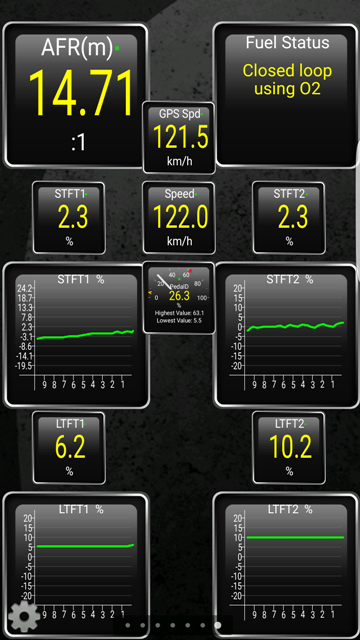
 ). Although Torque says I only ever get 92% throttle when it is on the floor. It goes open loop only when decelerating.


