"pipelines should be no closer than 100mm remote from the vehicle exhaust system. Where this is not practicable, the pipeline must be sheilded from the vehicle exhaust system by a suitiable heatsheild so as to ensure that the pipeline is not subjected to a temperature of 120 deg C "
also are you sure you have set your tank at 30 degrees, cant remember if you are using a cylinder or not. But the 4 hole vent box should be slightly lower than the top of the tank anyhow ?
DIY 2002 Daimler Super V8 (Jaguar XJR, X308 type)
Re: DIY 2002 Daimler Super V8 (Jaguar XJR, X308 type)
I think it says 250mm from the exhaust OUTLET, so not where pipework runs close-ish to the exhaust run but close to the outlet.
96 Saab 900XS, AEB Leo, sold
93 Range Rover 4.2LSE, Lovato LovEco, sold
97 Range Rover 4.0SE, multipoint, sold
98 Ex-Police Range Rover 4.0, AEB Leo, daily motor
96 Range Rover 4.6HSE Ascot, AEB Leo, my spare
Proud member of the YCHJCYA2PDTHFH club.
93 Range Rover 4.2LSE, Lovato LovEco, sold
97 Range Rover 4.0SE, multipoint, sold
98 Ex-Police Range Rover 4.0, AEB Leo, daily motor
96 Range Rover 4.6HSE Ascot, AEB Leo, my spare
Proud member of the YCHJCYA2PDTHFH club.
Re: DIY 2002 Daimler Super V8 (Jaguar XJR, X308 type)
The 250mm relates to exhaust outlet.
The vapour box does come a little proud of the top of 4-hole donut tanks, so yes some packing so that the floor doesn't bear on it.
The vapour box does come a little proud of the top of 4-hole donut tanks, so yes some packing so that the floor doesn't bear on it.
www.blazegas.com
-
markocosic
- Member
- Posts: 144
- Joined: Mon May 14, 2012 11:56 am
Re: DIY 2002 Daimler Super V8 (Jaguar XJR, X308 type)
Ah, I must have an older version of the document:
It's a multi-hole toroidal with a filled centre (Stako 720x270) and the vapour box sits slightly above it as rossko says. Dumb design...
Question on levelling:
How level...? The boot floor of an XJ slopes forwards by default by more than 5 degrees and less than 10 degrees. Provided that the stop-fill works reasonably accurately at 80% (can this be adjusted), does anybody care if the tank isn't completely level?
Question on valve location:
I'm assuming that the valve box needs to sit towards the rear of the vehicle to negate the effects of fuel slosh - correct, or does it pick up from the centre of the tank anyway?
Question on mountings:
30g decel on a 95 litre tank is in the region of 45,000N. Run the calcs at 200 MPa yield and you're talking 225mm^2 of mild steel to take that load - two 30x4 mm straps. Acceptable/certifiable to DIY these?
Day 3
Mostly spent f**king around with injector locations. These cars are TIGHT on engine bay space, and the HANA injectors are both large and without any convenient mountings. I've made brackets to sit either side of the charge coolers/intake plenums, that carry the injectors at 30 degrees from horizontal, pointing downwards and towards the rear of the car. An O-ring around the injector body and one of the soviet-block cable ties (10 mm x 0.7 mm steel, think pallet strapping/LPG tank mounting in miniature) holds them in. Outlet is 270 mm long x 5 mm dia. Feeds will vary in length and are 6 mm dia.
The single-vapouriser and switch completely to petrol over 3,500 rpm option, with the tiny little OMVL dream injectors that you replace every 20k and no flashlube (you're running petrol under high load and depositing enough rubbish/byproducts on valves) is increasingly attractive if I'm honest. Most of the benefit with an awful lot less pratting about. Will have to dig out the camera when done and show what fun it is fitting this little lot!
X350 (2003 on) is a piece of cake, as they have huge underbonnet clearance even on the Super V8s. Ditto the Range Rovers. Hardest part of this install is the fitting bits part of the jigsaw rather than the connecting the right bit to the right place part of the jigsaw.
One thing the STAG kit doesn't mention, but should be, is inertia switches. Cars have inertia switches. Check that the feed that you're using for igntion position II is one that is killed off when the inertia switch triggers in the event of a crash. The OBD socket on the X308 does this - earth, switched live, and your two CAN lines all in the same place. (no load is drawn from this line - the STAG ECU has a permanent live of it's own and switches this based on the ignition switched live.
It's about 100 mm. (where the pipe exits the boot near the "rear chassis leg" for those who know X308s) Piece of 30 mm dia thin steel pipe with the heatshield from some random scrapper wrapped around it? Off-the-shelf stuff that fits direct to the pipe and is neater?Pipelines should be remote from the vehicle exhaust system and not closer than
250mm.
Where the requirement of the above is not practicable, the pipeline must be shielded
from the vehicle exhaust system by a suitable heat shield.
It's a multi-hole toroidal with a filled centre (Stako 720x270) and the vapour box sits slightly above it as rossko says. Dumb design...
Question on levelling:
How level...? The boot floor of an XJ slopes forwards by default by more than 5 degrees and less than 10 degrees. Provided that the stop-fill works reasonably accurately at 80% (can this be adjusted), does anybody care if the tank isn't completely level?
Question on valve location:
I'm assuming that the valve box needs to sit towards the rear of the vehicle to negate the effects of fuel slosh - correct, or does it pick up from the centre of the tank anyway?
Question on mountings:
30g decel on a 95 litre tank is in the region of 45,000N. Run the calcs at 200 MPa yield and you're talking 225mm^2 of mild steel to take that load - two 30x4 mm straps. Acceptable/certifiable to DIY these?
Day 3
Mostly spent f**king around with injector locations. These cars are TIGHT on engine bay space, and the HANA injectors are both large and without any convenient mountings. I've made brackets to sit either side of the charge coolers/intake plenums, that carry the injectors at 30 degrees from horizontal, pointing downwards and towards the rear of the car. An O-ring around the injector body and one of the soviet-block cable ties (10 mm x 0.7 mm steel, think pallet strapping/LPG tank mounting in miniature) holds them in. Outlet is 270 mm long x 5 mm dia. Feeds will vary in length and are 6 mm dia.
The single-vapouriser and switch completely to petrol over 3,500 rpm option, with the tiny little OMVL dream injectors that you replace every 20k and no flashlube (you're running petrol under high load and depositing enough rubbish/byproducts on valves) is increasingly attractive if I'm honest. Most of the benefit with an awful lot less pratting about. Will have to dig out the camera when done and show what fun it is fitting this little lot!
X350 (2003 on) is a piece of cake, as they have huge underbonnet clearance even on the Super V8s. Ditto the Range Rovers. Hardest part of this install is the fitting bits part of the jigsaw rather than the connecting the right bit to the right place part of the jigsaw.
One thing the STAG kit doesn't mention, but should be, is inertia switches. Cars have inertia switches. Check that the feed that you're using for igntion position II is one that is killed off when the inertia switch triggers in the event of a crash. The OBD socket on the X308 does this - earth, switched live, and your two CAN lines all in the same place. (no load is drawn from this line - the STAG ECU has a permanent live of it's own and switches this based on the ignition switched live.
Re: DIY 2002 Daimler Super V8 (Jaguar XJR, X308 type)
Bodge. You want a car that runs on LPG, not one that runs on LPG sometimes......markocosic wrote:The single-vapouriser and switch completely to petrol over 3,500 rpm option
By the way, I'm not posting at stupid o'clock, it's only 11pm where I am at the moment!
96 Saab 900XS, AEB Leo, sold
93 Range Rover 4.2LSE, Lovato LovEco, sold
97 Range Rover 4.0SE, multipoint, sold
98 Ex-Police Range Rover 4.0, AEB Leo, daily motor
96 Range Rover 4.6HSE Ascot, AEB Leo, my spare
Proud member of the YCHJCYA2PDTHFH club.
93 Range Rover 4.2LSE, Lovato LovEco, sold
97 Range Rover 4.0SE, multipoint, sold
98 Ex-Police Range Rover 4.0, AEB Leo, daily motor
96 Range Rover 4.6HSE Ascot, AEB Leo, my spare
Proud member of the YCHJCYA2PDTHFH club.
-
markocosic
- Member
- Posts: 144
- Joined: Mon May 14, 2012 11:56 am
Re: DIY 2002 Daimler Super V8 (Jaguar XJR, X308 type)
Say that again after driving/converting one... 
The objective is a car that's cheaper to run, and I think it'd be cheaper to run the car on mostly LPG and partly petrol if you do the sums/were paying somebody to fit the kit.
3,500 rpm is 200 bhp and more than keeping pace with most traffic. In town, you never use more. Normal mode always sets off in 2nd. Sport mode sets off in 1st but it'll light up the rear wheels on anything other than straight ahead and dry roads. On the motorway, you'd only ever use more for entertainment. On A and B-roads you use more, but only when encountering caravans/trucks/grandpas.
This is bodge:
http://www.lpginfo.co.uk/images/golpgfu ... C00296.JPG
http://www.lpginfo.co.uk/images/golpgin ... ure004.jpg
This looks tidy at first glance:
http://www.go-lpg.co.uk/XKR_Engine_LHS.JPG
But I shudder to think how long the injector pipe runs are and how the injectors/rails are mounted. The pipes are exiting under the back of the plenum (400 mm minimum) and the injectors/rails will be sat right on top of the exhaust manifolds/catalysts.
The objective is a car that's cheaper to run, and I think it'd be cheaper to run the car on mostly LPG and partly petrol if you do the sums/were paying somebody to fit the kit.
3,500 rpm is 200 bhp and more than keeping pace with most traffic. In town, you never use more. Normal mode always sets off in 2nd. Sport mode sets off in 1st but it'll light up the rear wheels on anything other than straight ahead and dry roads. On the motorway, you'd only ever use more for entertainment. On A and B-roads you use more, but only when encountering caravans/trucks/grandpas.
This is bodge:
http://www.lpginfo.co.uk/images/golpgfu ... C00296.JPG
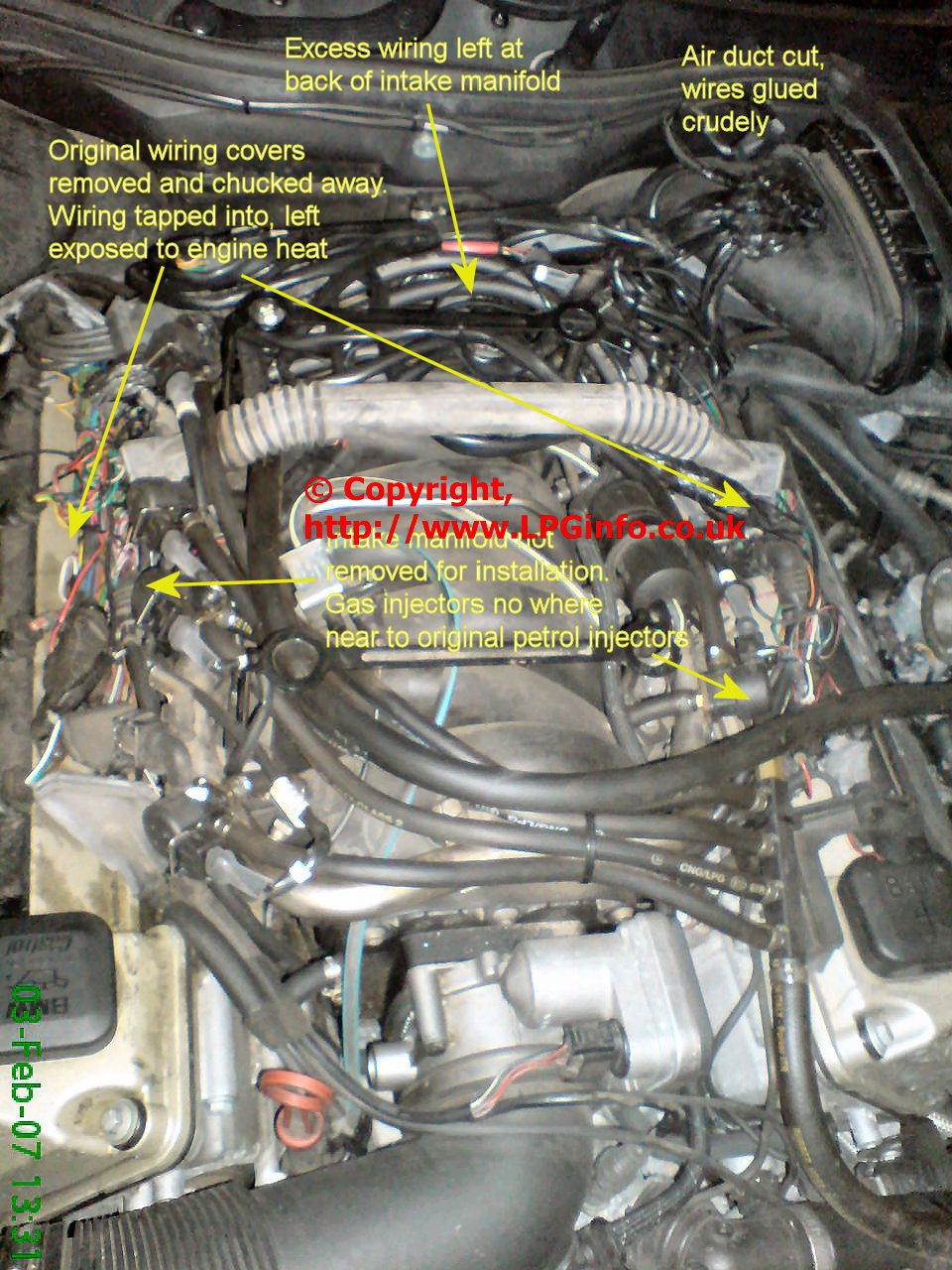
http://www.lpginfo.co.uk/images/golpgin ... ure004.jpg
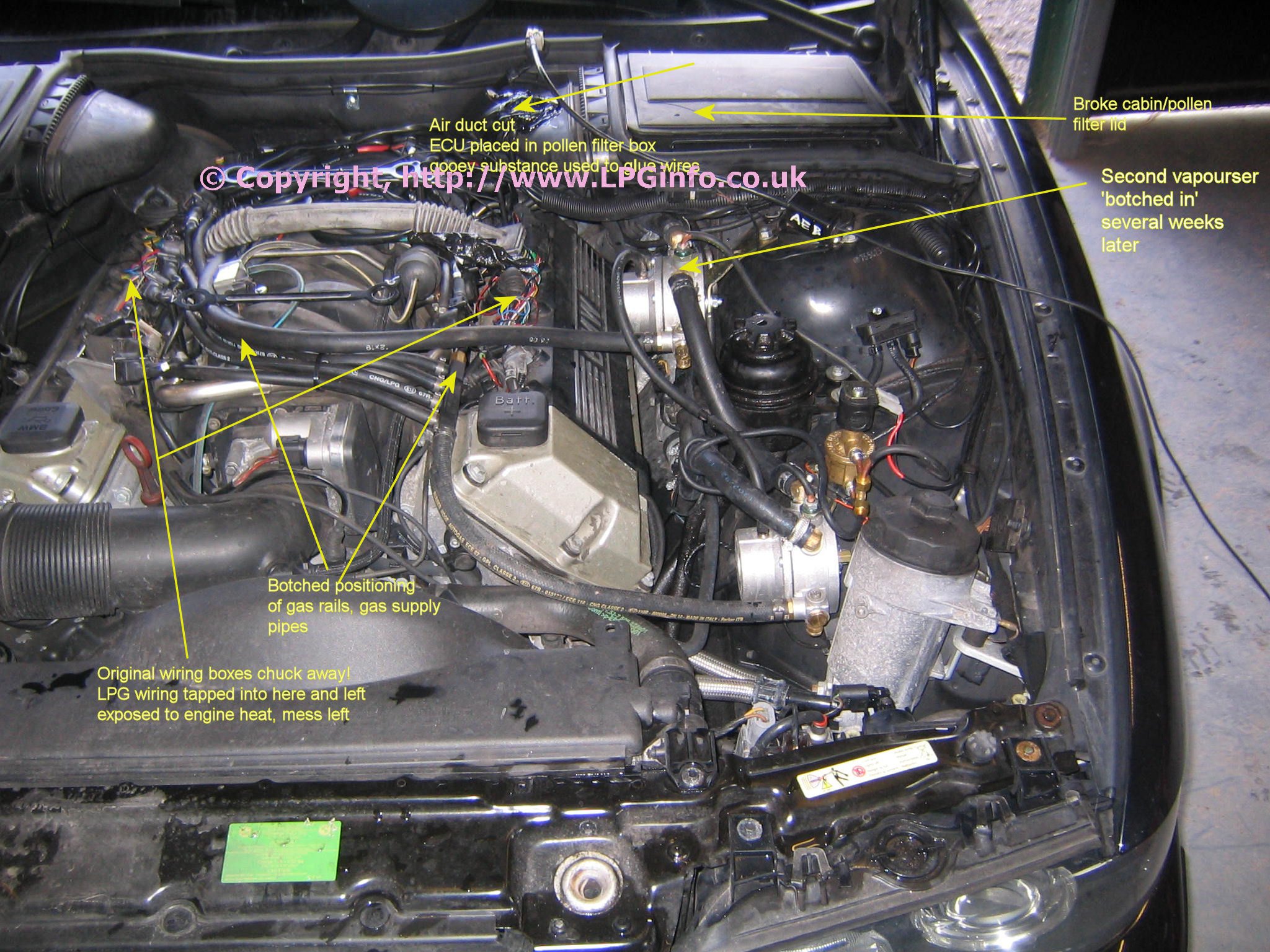
This looks tidy at first glance:
http://www.go-lpg.co.uk/XKR_Engine_LHS.JPG

But I shudder to think how long the injector pipe runs are and how the injectors/rails are mounted. The pipes are exiting under the back of the plenum (400 mm minimum) and the injectors/rails will be sat right on top of the exhaust manifolds/catalysts.
-
mat_fenwick
- Intermediate Member
- Posts: 920
- Joined: Mon Jun 21, 2010 10:19 am
- Location: North Wales
Re: DIY 2002 Daimler Super V8 (Jaguar XJR, X308 type)
I may be wrong, but does this matter? If the existing inertia switch cuts the petrol injector pulses, the engine will stop and hence the LPG system will cut off. Or does the inertia switch on some vehicles only cut the fuel pump?markocosic wrote:Cars have inertia switches. Check that the feed that you're using for igntion position II is one that is killed off when the inertia switch triggers in the event of a crash.
Another member of the YCHJCYA2PDTHFH club
Re: DIY 2002 Daimler Super V8 (Jaguar XJR, X308 type)
Those pictures show installation bodges but what I mean is that a system, no matter how well installed, is a bodge if it has to resort to switching over to petrol under high demand. Think about it, if I drive like a granny I can get 20mpg on petrol out of my car so that is almost acceptable running costs. If I poke the sport button and floor it, I'm down into single figures. Surely if I'm using that amount of fuel it is preferable that I'm doing that on the cheaper fuel and not the most expensive one. If you had to run both fuels, a system that ran on petrol under normal running conditions but switched to LPG at high demand would be preferable. Use the cheaper fuel at times when you are using the most.markocosic wrote:This is bodge:
http://www.lpginfo.co.uk/images/golpgfu ... C00296.JPG
http://www.lpginfo.co.uk/images/golpgin ... ure004.jpg
This looks tidy at first glance:
http://www.go-lpg.co.uk/XKR_Engine_LHS.JPG
96 Saab 900XS, AEB Leo, sold
93 Range Rover 4.2LSE, Lovato LovEco, sold
97 Range Rover 4.0SE, multipoint, sold
98 Ex-Police Range Rover 4.0, AEB Leo, daily motor
96 Range Rover 4.6HSE Ascot, AEB Leo, my spare
Proud member of the YCHJCYA2PDTHFH club.
93 Range Rover 4.2LSE, Lovato LovEco, sold
97 Range Rover 4.0SE, multipoint, sold
98 Ex-Police Range Rover 4.0, AEB Leo, daily motor
96 Range Rover 4.6HSE Ascot, AEB Leo, my spare
Proud member of the YCHJCYA2PDTHFH club.
-
mat_fenwick
- Intermediate Member
- Posts: 920
- Joined: Mon Jun 21, 2010 10:19 am
- Location: North Wales
Re: DIY 2002 Daimler Super V8 (Jaguar XJR, X308 type)
I suppose it depends on what proportion of the time you spend driving it hard, and whether the increased fuel costs outweigh the extra time and money performing a fully capable conversion. 5% of the time spent in single figure consumption on twice the price fuel still isn't *that* significant. The engineer in me wouldn't really be happy with such a system, but I can see the OP's point.
Another member of the YCHJCYA2PDTHFH club
-
markocosic
- Member
- Posts: 144
- Joined: Mon May 14, 2012 11:56 am
Re: DIY 2002 Daimler Super V8 (Jaguar XJR, X308 type)
The injectors don't really matter to be honest. Only a small amount of fuel in those lines that can pop but not cause fire. It's the solenoid valve on the tank and the solenoid valves on the vapouriser(s) that you want to shut off, as these could could a real fire.I may be wrong, but does this matter? If the existing inertia switch cuts the petrol injector pulses, the engine will stop and hence the LPG system will cut off. Or does the inertia switch on some vehicles only cut the fuel pump?
These are switched by the gas ECU and that is on when the ignition is on and the switch is set to gas. If your ignition II feed comes via the inertia switch, then when you bend the car the ignition II feed to the gas ECU is cut so the feed to the solenoid/liquid valves is cut.
If your ignition II feed comes before the inertia switch (eg, ignition switch, radio feed, wherever the installer scotchlocked it in) then when you bend the car the gas ECU stays powered and the solenoid/liquid valves stay open. In some circumstances (partially severed liquid feed line etc) this could be bad.
On the X308 the OBD socket is convenient. Fused at 5 amps already, and had your ign2 via the inertia switch, earth, and CAN lines. Some cars only cut the fuel pump supply (I think the old Rover 800 we had did this) so you'd want to find that feed to to the "turn on" signal for your gas ECU.
LPGA says it's mandatory for buses, but not for cars. I'd do it on the car too - daft not to!
-
mat_fenwick
- Intermediate Member
- Posts: 920
- Joined: Mon Jun 21, 2010 10:19 am
- Location: North Wales
Re: DIY 2002 Daimler Super V8 (Jaguar XJR, X308 type)
I'm willing to be corrected, but I believe that the LPG ECU only open the solenoids when about to run on gas, not simply when the ignition is turned on, and without a signal from the coil or injector pulses, would shut off. I can't see a problem with the way you've done it though, especially as it makes sense to make as many connections as possible in the same place.
Another member of the YCHJCYA2PDTHFH club
Re: DIY 2002 Daimler Super V8 (Jaguar XJR, X308 type)
Like ee said, no they ain't.markocosic wrote:[solenoids]These are switched by the gas ECU and that is on when the ignition is on and the switch is set to gas.
Some systems do give the solenoids a dab to pre-pressurise the system when temperature has been reached, otherwise they are only turned on while gas is being delivered.
E67 mandates a fuel cutoff if the engine has stopped; every injection system implements that with RPM detection, shutting solenoids in the event of a stall.
Tank valves incorporate mechanical protection against severed pipes by way of excess flow valves. It's difficult to concieve of any partial severing of an LPG pipeline that wouldn't stall the engine (remember this stuff boils off when exposed to atmospheric pressure, it's not like petrol or diesel). I would reckon that's why E67 makes no other special provision for it.
Follow the CoP and you'll be fine.
www.blazegas.com
-
markocosic
- Member
- Posts: 144
- Joined: Mon May 14, 2012 11:56 am
Re: DIY 2002 Daimler Super V8 (Jaguar XJR, X308 type)
That would make sense Matt - only open the LPG liquid solenoids if you see some injector pulses or rpms, so in the event of a smack and the engine dies it kills the liquid feed.
Provided that the the inertia switch kills the OEM ECU's injector pulses then it doesn't matter where you take your ignition II feed from - it'll act as a secondary failsafe for the gas system, save for the scenario where the inertia switch only kills the fuel pump, not the ECU. Can't imagine any OEM wiring that way though. Taking a feed that gets killed by the inertia switch directly removes all guessing. Non-zero rpms or not, the fuel system goes into shutdown in the event that the inertia switch is tripped. The (conveniently located) OBD on the X308 is one of these.
Interesting aside - they forgot to programme the instsrument cluster on the X308 with a "you have crashed" message. Pop the inertia switch and the instrument cluster goes nuts. "Incorrect part fitted," "Gearbox Fault," "ASC Unavailable," "Trac Unavailable," "Engine Failsafe Mode," "Passenger Door Open," "Driver's Door Open" and so forth. Instrument cluster has power but none of the other devices on the CAN bus or SCP bus do, so it goes nuts looking. Scratch your head and hook up an OBD reader and it'll not connect either, as it's power is off too... (I knocked the inertia switch when refitting ALL the wiring/modules to the convertible X308 and spent a good half day scratching my head over that one!)
Back to LPG though:
Quality time with some 8 mm copper pipe today. Deep joy in a crowded engine bay, but with patience it isn't too bad at all. Pipe from the tank mimics the OE fuel pipe run from the passenger side on the driver's side, diverting from "underfloor" along the top-hat floor stiffener section to "transmission tunnel" just behind the gearbox crossmember. (about where the front seat crossmember is) Run along the transmission tunnel behind the heatshield, then up into the engine bay in the corner nearest the brake pedal, forward along the chassis rail to the shock tower, into the tee and the liquid filters (mounted to a bracket that bolts to the shock tower), then from them back along the chassis rail, across the top of the bulkhead, and over to the passenger side shock tower where the two vapourisers are mounted.
Use lots of those plastic coated P-Clips designed for M6 bolts. There are a stack across the bulkehad that you can re-user/double up on to P-Clip the pipes, and everywhere else you can use M6 rivnuts. (Beal UK sell them for pennies, and you don't need any special tools to fit them, just a 3/8" drill, a strip of steel with a 6 mm hole in it, a nut and bolt, and two spanners. Will post a photo at some point. Use step-drills for drilling sheetmetal rather than twist drills, as they won't grab and you don't need much depth behind the panel.
Straighten the pipe BEFORE you cut it. If you don't, you'll never be able to straighten the very end of the pipe as there's nothing to grab hold of. A drill bit or plain punch in the end of the pipe (insert to 30 mm depth) helps keep a straight bit for the fitting when you're bending. The CoP asks for strain reliefs - these are your friend when fitting anyway. Try to make everything have an "S" shaped end. This allows for movement in every direction when assembling, and will strain relieve the pipe for expansion/contraction too.
Jaguar heatshield nuts. Jaguars have small studs with odd coarse threads on the bodyshell that the heatshields fit over. They then have little plastic (ok, phenolic) nuts that screw over them. The first time that you drive the car hard then slow down for traffic, these nuts melt/deploymerise and turn to dust followed by the heatshields rattling. If not, after 10 years they'll crumble if you touch them to move the heatshields to fit the LPG pipe. Instead of buying new ones, grab a brass or alloy nut, and run a #20-24 tap through it. (American thread between M5 and M6 with a coarse pitch) This is close enough to the wierdo thread used on the body studs to fit, and you can cinch those heatshields back down tight again. Especially useful where they're now protecting an extra 8 mm of LPG pipe.
Provided that the the inertia switch kills the OEM ECU's injector pulses then it doesn't matter where you take your ignition II feed from - it'll act as a secondary failsafe for the gas system, save for the scenario where the inertia switch only kills the fuel pump, not the ECU. Can't imagine any OEM wiring that way though. Taking a feed that gets killed by the inertia switch directly removes all guessing. Non-zero rpms or not, the fuel system goes into shutdown in the event that the inertia switch is tripped. The (conveniently located) OBD on the X308 is one of these.
Interesting aside - they forgot to programme the instsrument cluster on the X308 with a "you have crashed" message. Pop the inertia switch and the instrument cluster goes nuts. "Incorrect part fitted," "Gearbox Fault," "ASC Unavailable," "Trac Unavailable," "Engine Failsafe Mode," "Passenger Door Open," "Driver's Door Open" and so forth. Instrument cluster has power but none of the other devices on the CAN bus or SCP bus do, so it goes nuts looking. Scratch your head and hook up an OBD reader and it'll not connect either, as it's power is off too... (I knocked the inertia switch when refitting ALL the wiring/modules to the convertible X308 and spent a good half day scratching my head over that one!)
Back to LPG though:
Quality time with some 8 mm copper pipe today. Deep joy in a crowded engine bay, but with patience it isn't too bad at all. Pipe from the tank mimics the OE fuel pipe run from the passenger side on the driver's side, diverting from "underfloor" along the top-hat floor stiffener section to "transmission tunnel" just behind the gearbox crossmember. (about where the front seat crossmember is) Run along the transmission tunnel behind the heatshield, then up into the engine bay in the corner nearest the brake pedal, forward along the chassis rail to the shock tower, into the tee and the liquid filters (mounted to a bracket that bolts to the shock tower), then from them back along the chassis rail, across the top of the bulkhead, and over to the passenger side shock tower where the two vapourisers are mounted.
Use lots of those plastic coated P-Clips designed for M6 bolts. There are a stack across the bulkehad that you can re-user/double up on to P-Clip the pipes, and everywhere else you can use M6 rivnuts. (Beal UK sell them for pennies, and you don't need any special tools to fit them, just a 3/8" drill, a strip of steel with a 6 mm hole in it, a nut and bolt, and two spanners. Will post a photo at some point. Use step-drills for drilling sheetmetal rather than twist drills, as they won't grab and you don't need much depth behind the panel.
Straighten the pipe BEFORE you cut it. If you don't, you'll never be able to straighten the very end of the pipe as there's nothing to grab hold of. A drill bit or plain punch in the end of the pipe (insert to 30 mm depth) helps keep a straight bit for the fitting when you're bending. The CoP asks for strain reliefs - these are your friend when fitting anyway. Try to make everything have an "S" shaped end. This allows for movement in every direction when assembling, and will strain relieve the pipe for expansion/contraction too.
Jaguar heatshield nuts. Jaguars have small studs with odd coarse threads on the bodyshell that the heatshields fit over. They then have little plastic (ok, phenolic) nuts that screw over them. The first time that you drive the car hard then slow down for traffic, these nuts melt/deploymerise and turn to dust followed by the heatshields rattling. If not, after 10 years they'll crumble if you touch them to move the heatshields to fit the LPG pipe. Instead of buying new ones, grab a brass or alloy nut, and run a #20-24 tap through it. (American thread between M5 and M6 with a coarse pitch) This is close enough to the wierdo thread used on the body studs to fit, and you can cinch those heatshields back down tight again. Especially useful where they're now protecting an extra 8 mm of LPG pipe.
-
markocosic
- Member
- Posts: 144
- Joined: Mon May 14, 2012 11:56 am
Re: DIY 2002 Daimler Super V8 (Jaguar XJR, X308 type)
Replied as I was typing. Makes perfect sense rossko, thanks.
A split (partially severed) line and a vehicle without inertia switch or where the inertia switch only cuts the petrol fuel pump would continue to run quite happily in a cloud of LPG vapour. There are less rare and riskier circumstances for the regs to be concentrating on though!
A split (partially severed) line and a vehicle without inertia switch or where the inertia switch only cuts the petrol fuel pump would continue to run quite happily in a cloud of LPG vapour. There are less rare and riskier circumstances for the regs to be concentrating on though!
-
markocosic
- Member
- Posts: 144
- Joined: Mon May 14, 2012 11:56 am
Re: DIY 2002 Daimler Super V8 (Jaguar XJR, X308 type)
Heat shield for the liquid feed pipe where it passes within ~100 mm of the exhaust pipe near the rear box:
http://www.ebay.co.uk/itm/1M-HEAT-WRAP- ... _921wt_754
Insulate the exhaust pipe rather than the fuel pipe? It's a little mickey-mouse, but the exhaust is cold at that end anyhow. (at the front I'm running behind the factory heatshields - alloy-insulation-alloy sandwiches)
http://www.ebay.co.uk/itm/1M-HEAT-WRAP- ... _921wt_754
Insulate the exhaust pipe rather than the fuel pipe? It's a little mickey-mouse, but the exhaust is cold at that end anyhow. (at the front I'm running behind the factory heatshields - alloy-insulation-alloy sandwiches)
Re: DIY 2002 Daimler Super V8 (Jaguar XJR, X308 type)
No it wouldn't. There may be enough remaining pressure to supply sufficient gas at idle but not as soon as you gave it any throttle.markocosic wrote:A split (partially severed) line and a vehicle without inertia switch or where the inertia switch only cuts the petrol fuel pump would continue to run quite happily in a cloud of LPG vapour.
I'm in a timezone that's 5 hours behind the UK so I'm posting at before 11pm, what's your excuse, don't you have a bed to go to?
96 Saab 900XS, AEB Leo, sold
93 Range Rover 4.2LSE, Lovato LovEco, sold
97 Range Rover 4.0SE, multipoint, sold
98 Ex-Police Range Rover 4.0, AEB Leo, daily motor
96 Range Rover 4.6HSE Ascot, AEB Leo, my spare
Proud member of the YCHJCYA2PDTHFH club.
93 Range Rover 4.2LSE, Lovato LovEco, sold
97 Range Rover 4.0SE, multipoint, sold
98 Ex-Police Range Rover 4.0, AEB Leo, daily motor
96 Range Rover 4.6HSE Ascot, AEB Leo, my spare
Proud member of the YCHJCYA2PDTHFH club.
-
markocosic
- Member
- Posts: 144
- Joined: Mon May 14, 2012 11:56 am
Re: DIY 2002 Daimler Super V8 (Jaguar XJR, X308 type)
If a line can supply 400 bhp normally then it can quite happily supply 50 bhp for an engine and 350 bhp for fire - excess flow doesn't know the difference.
What am I doing at 2am? Finishing up for the night. Work, then work on LPGing this beastie. Early night tonight though as I'm cream crackered.
Back on topic though...
LPG Electrics:
The Stag kit has plug and play for the car injectors with the Bosch style connections, then wires for each device: gas map/temperature sensor, vapouriser temperature sensor, two for oxygen sensor inputs, an ignition coil input, permanent live/permanent earth, switched live/OBD feed, lpg level sensor, level gauge/changeover switch, and the liquid solenoid valve supplies.
These could be better thought out. If it were me, I'd have the tank level sensor and a pair of solenoid valve wires in one bundle, and the vapouriser temperature wires and a pair of solenoid valve wires in another bundle. (Tee at the main connector and strain relieved by that) As it stands, one of the first things you'll need to do is tee the solenoid valve wiring off. Do this with the harness on the bench, as close to the ECU as you can.
The temperature sensor for the vapourisers has no connector with it, and to make matters worse it is a screw in affair so you need to fit then wire, and once fitted you can't remove it as unscrewing the sensor will badly twist the wires. Buy yourself some waterproof inline connectors before you start. I'd use the superseal style male/female ones:
http://translate.googleusercontent.com/ ... eR8psjExHA
Ditto where you need to connect to the car elsewhere. Better to "tap" the car wiring and run the pigtail to a plug, than to permanently attach to the car wiring. One plug for each oxygen sensor "tap" and one plug for the ignition coil "tap" as a start. A couple more for the LPG tank; one for level gauge, one for solenoid valve, such that the tank is reasonably removable wouldn't go amiss either.
I didn't think of these in advance (plug and play, right?) and will have to pay through the nose for these now.
Oh, and the Stag MAP/temperature sensor. If you need to extend the wiring, don't just cut the cable. Nothing special about it (all 16 gauge copper), but three of the wires are pure white and marked at their ends only. You'll get familiar with the connector diagrams and belling things through if you just chop the lot in one go!
What am I doing at 2am? Finishing up for the night. Work, then work on LPGing this beastie. Early night tonight though as I'm cream crackered.
Back on topic though...
LPG Electrics:
The Stag kit has plug and play for the car injectors with the Bosch style connections, then wires for each device: gas map/temperature sensor, vapouriser temperature sensor, two for oxygen sensor inputs, an ignition coil input, permanent live/permanent earth, switched live/OBD feed, lpg level sensor, level gauge/changeover switch, and the liquid solenoid valve supplies.
These could be better thought out. If it were me, I'd have the tank level sensor and a pair of solenoid valve wires in one bundle, and the vapouriser temperature wires and a pair of solenoid valve wires in another bundle. (Tee at the main connector and strain relieved by that) As it stands, one of the first things you'll need to do is tee the solenoid valve wiring off. Do this with the harness on the bench, as close to the ECU as you can.
The temperature sensor for the vapourisers has no connector with it, and to make matters worse it is a screw in affair so you need to fit then wire, and once fitted you can't remove it as unscrewing the sensor will badly twist the wires. Buy yourself some waterproof inline connectors before you start. I'd use the superseal style male/female ones:
http://translate.googleusercontent.com/ ... eR8psjExHA
Ditto where you need to connect to the car elsewhere. Better to "tap" the car wiring and run the pigtail to a plug, than to permanently attach to the car wiring. One plug for each oxygen sensor "tap" and one plug for the ignition coil "tap" as a start. A couple more for the LPG tank; one for level gauge, one for solenoid valve, such that the tank is reasonably removable wouldn't go amiss either.
I didn't think of these in advance (plug and play, right?) and will have to pay through the nose for these now.
Oh, and the Stag MAP/temperature sensor. If you need to extend the wiring, don't just cut the cable. Nothing special about it (all 16 gauge copper), but three of the wires are pure white and marked at their ends only. You'll get familiar with the connector diagrams and belling things through if you just chop the lot in one go!
-
mat_fenwick
- Intermediate Member
- Posts: 920
- Joined: Mon Jun 21, 2010 10:19 am
- Location: North Wales
Re: DIY 2002 Daimler Super V8 (Jaguar XJR, X308 type)
I don't want to sound critical, but this may be one of the reasons it's cheaper than say an equivalent AEB based unit. Obviously it doesn't affect functionality, so most people would deem it a fair trade off for the cost saving. I think that my system had the wires arranged in slightly more logical bundles, but I still had to shorten/extend some wires to avoid messy cable runs or bundles of excess cable. I've actually gone the opposite way to you, and integrated it within the OE loom as much as possible (all soldered) and running within the same trunking. I may live to regret this if I ever have cause to remove the system!markocosic wrote:The temperature sensor for the vapourisers has no connector with it, and to make matters worse it is a screw in affair so you need to fit then wire, and once fitted you can't remove it as unscrewing the sensor will badly twist the wires.
Another member of the YCHJCYA2PDTHFH club
-
markocosic
- Member
- Posts: 144
- Joined: Mon May 14, 2012 11:56 am
Re: DIY 2002 Daimler Super V8 (Jaguar XJR, X308 type)
The other way around for actually - the Italian AEB based kit is the absolute cheapest stuff around once you're in 8cyl OBD enabled flavour:
http://translate.googleusercontent.com/ ... Ej-NlalMcA
http://translate.googleusercontent.com/ ... AWOMAB06Gw
All goes a bit screwy once you're into their "bundles" though as the relative pricing is all over the show. Check Kit 2267 (Stag, KME Silver, OMVL @ 368 euro) vs 3803 (AEB-King, KME Silver, OMVL @ 288 euro) as an example.
I bought the Kit 2257 (Stag, KME Gold Turbo, HANA @ 495 euro) over the Kit 3476 (AEB-King, KME Gold Turbo, HANA @ 425 euro) because I wanted the plug and play harness and preferred the AC software over the AEB software. (didn't look like a child had written it in Visual Basic in 1998)
Kit 3786 (AEB, KME Gold Turbo, HANA Strip) at 435 euro was tempting, but there's just no room under the bonnet to mount a HANA strip in the correct orientation.
They seem to be out of MagicJets at the minute, but if I were to do this again I'd go with a pair of their reducers and two OMVL strips just for packaging reasons.
http://translate.googleusercontent.com/ ... Ej-NlalMcA
http://translate.googleusercontent.com/ ... AWOMAB06Gw
All goes a bit screwy once you're into their "bundles" though as the relative pricing is all over the show. Check Kit 2267 (Stag, KME Silver, OMVL @ 368 euro) vs 3803 (AEB-King, KME Silver, OMVL @ 288 euro) as an example.
I bought the Kit 2257 (Stag, KME Gold Turbo, HANA @ 495 euro) over the Kit 3476 (AEB-King, KME Gold Turbo, HANA @ 425 euro) because I wanted the plug and play harness and preferred the AC software over the AEB software. (didn't look like a child had written it in Visual Basic in 1998)
Kit 3786 (AEB, KME Gold Turbo, HANA Strip) at 435 euro was tempting, but there's just no room under the bonnet to mount a HANA strip in the correct orientation.
They seem to be out of MagicJets at the minute, but if I were to do this again I'd go with a pair of their reducers and two OMVL strips just for packaging reasons.
Re: DIY 2002 Daimler Super V8 (Jaguar XJR, X308 type)
Yes the AEB system is a lot better thought out...full stop in my opinion. The systems you are looking at are cheap anyway, king ecu, kme gold reducers (or the drifter as they are also known, make sure you can get to the pressure adjuster) hana injectors definately show some promise. They are relitively new on the market in the uk. All the polish and european companies are really pushing them hard at the mo. As you have found out though, they are chunky buggers and make things harder from a tight install scenario. Back engineered from the Kehin injectors. Under licence meaning they have to pay Keihin per unit becuase Keihin hold the patent in all probibility.
It has dedicated rear solenoid wiring and the level sender at the same length. Im not sure if the stag sytem has a dedicated rear solenoid wire. But its useful for rear solenoid on in advance. And also for diagnosis. But as you say, if you work with them every day and know your way around the system its just a lot more intuitive i suppose. Yeh the sofware interface isnt as flowery, personally id rather be able to tune well than have more of an oem feel on screen. Ive found with stag, kme etc, they do a lot of stuff, and you have a lot of stuff to fiddle with but they make lots of difference when you want a little bit or none where you want a lot. Aeb stuff you can choke the engine rich if you want or hang it lean all the way up the rev range if you are that stupid !
Magic jets are ok, but they dont flow anywhere near as well as they reckon. Emer 34's flow far more than they reckon, the table doesnt go up anywhere near what they will go to ive pushed up to 260bhp with a dyno ticket to prove it, on a 4 cylinder. 3mm rails. Using one Palladio reducer. Absolutely clean as a whistle, infact i had to back it off at the top as it was running rich.
It has dedicated rear solenoid wiring and the level sender at the same length. Im not sure if the stag sytem has a dedicated rear solenoid wire. But its useful for rear solenoid on in advance. And also for diagnosis. But as you say, if you work with them every day and know your way around the system its just a lot more intuitive i suppose. Yeh the sofware interface isnt as flowery, personally id rather be able to tune well than have more of an oem feel on screen. Ive found with stag, kme etc, they do a lot of stuff, and you have a lot of stuff to fiddle with but they make lots of difference when you want a little bit or none where you want a lot. Aeb stuff you can choke the engine rich if you want or hang it lean all the way up the rev range if you are that stupid !
Magic jets are ok, but they dont flow anywhere near as well as they reckon. Emer 34's flow far more than they reckon, the table doesnt go up anywhere near what they will go to ive pushed up to 260bhp with a dyno ticket to prove it, on a 4 cylinder. 3mm rails. Using one Palladio reducer. Absolutely clean as a whistle, infact i had to back it off at the top as it was running rich.